The moment the Eminent Surgeon came into the ward and told us that Tom's second implant operation had gone to plan has entered the list of 'critical moments' that have accumulated over the past five months. Almost immediately, the painfully tight, knotted muscles across my neck and shoulders that have been the main physical manifestation of my stress began to ease.
The second implant had come to mean so much to Nik and I in our striving to secure the best possible treatment for Tom. Along with caring for our son, the language therapy and the business of earning enough money to keep a roof over our heads, little else has occupied our thoughts for the longest time. Now it doesn't so what happens next?
Well, in descending order of importance:
Tom is recovering well from the operation. The swelling is slightly further back on his head than last time and so there has been far less distortion to his face.
Tom's vocabulary continues to grow at a tremendous rate and he's made that leap into talking about past events; more specifically, going for rides on Thomas the Tank Engine and a bus last Sunday.
'Tom-Tom in Thomas!', 'Diesel', 'Tom-Tom sat down in the bus!'.
Nik's extended leave from work is coming under closer scrutiny and the pressure to return soon, at least to some extent, is building. This has forced us to confront a number of issues that had seemed far enough in the future as to be safely ignored; namely, how much money do we need to live, where will said money come from and how will work be fitted around the seemingly endless appointments?
Add to that the age-old (well, last twenty years or so) dilemma about how prepared we are to let some of Tom's care be in someone else's hands now? The normal, protective feelings have been heightened at the exact time when Tom needs to mix more with his peers and begin to develop those all-important social interactions. Will the childminder talk to Tom as much as we do and in the right way (therapy does that to you!)?
Reading these last two paragraphs back elicits a wry smile - all the issues are the exact same ones we and all parents deal with from the moment junior first appears. We may have a few more appointments than the average and Tom's needs language-wise are more acute than they were but some semblance of normality has descended.
Thursday, September 28, 2006


Sunday, September 24, 2006
'All Done'
In Tom's words, we are 'All done'.
For the bionic ear cognoscenti this interprets as the implantation of a HiRes 90K device has been achieved in Tom's left side with full insertion of the electrode array into his cochlea. Minimal ossification was encountered and surgery was straightforward apart from 'a minor frisson' (surgeon's own words) at the basal turn.
For the rest... well it was the best it could possibly be. Our fears of a wide ranging spectrum of complications and possibilities of poor surgical outcomes that this may lead to have all, thus far, come to nothing.
We are home and, as I write, Tom is enjoying an extended lunchtime nap. He is now bilaterally implanted; one side 'belongs' to the NHS, the other is all bought and paid for thanks to the tear-inducing generosity of family, friends and complete strangers. In lieu of a more extended discourse on kindness and what you all mean to us, thank you.
For the bionic ear cognoscenti this interprets as the implantation of a HiRes 90K device has been achieved in Tom's left side with full insertion of the electrode array into his cochlea. Minimal ossification was encountered and surgery was straightforward apart from 'a minor frisson' (surgeon's own words) at the basal turn.
For the rest... well it was the best it could possibly be. Our fears of a wide ranging spectrum of complications and possibilities of poor surgical outcomes that this may lead to have all, thus far, come to nothing.
We are home and, as I write, Tom is enjoying an extended lunchtime nap. He is now bilaterally implanted; one side 'belongs' to the NHS, the other is all bought and paid for thanks to the tear-inducing generosity of family, friends and complete strangers. In lieu of a more extended discourse on kindness and what you all mean to us, thank you.
Friday, September 22, 2006
Extracts from Tom's Diary
Monday
Went on an airplane - told everyone about it. Over and over.
Played with Joe. He's great. He's got lots of trains. I want them all.
Tuesday
Played with Joe some more. Went home for my tea. Didn't get his trains.
Wednesday
Went to this place with lots of smiley ladies. They stuck a needle in me. I cried. Alot. I like smiley ladies though.
Thursday
Went out in the car with Mummy and Daddy. Went a long way and found lots of people with stripey uniforms. They tried to hold me down and put me in this tunnel. I wasn't having it. I screamed. Mummy cried. Got lots of chocolate.
Sometimes I'm not sure about Mummy and Daddy.
Friday
Went out in the car to see Kim and Mark. They have lots of toys. They make funny noises and I look and everyone smiles.
I like the dancing cow best. And the dinosaur.
Saturday
...
Tom doesn't yet know that Saturday will involve another short car journey and more stripey uniforms. Tomorrow, at 6.30am, we're due at the QMC for Tom's second cochlear implantation. I'll explain more about how we got to this point another time (for it is a twisting tale within this longer odyssey). Briefly then, the week has featured:
Went on an airplane - told everyone about it. Over and over.
Played with Joe. He's great. He's got lots of trains. I want them all.
Tuesday
Played with Joe some more. Went home for my tea. Didn't get his trains.
Wednesday
Went to this place with lots of smiley ladies. They stuck a needle in me. I cried. Alot. I like smiley ladies though.
Thursday
Went out in the car with Mummy and Daddy. Went a long way and found lots of people with stripey uniforms. They tried to hold me down and put me in this tunnel. I wasn't having it. I screamed. Mummy cried. Got lots of chocolate.
Sometimes I'm not sure about Mummy and Daddy.
Friday
Went out in the car to see Kim and Mark. They have lots of toys. They make funny noises and I look and everyone smiles.
I like the dancing cow best. And the dinosaur.
Saturday
...
Tom doesn't yet know that Saturday will involve another short car journey and more stripey uniforms. Tomorrow, at 6.30am, we're due at the QMC for Tom's second cochlear implantation. I'll explain more about how we got to this point another time (for it is a twisting tale within this longer odyssey). Briefly then, the week has featured:
- a vaccination for a bacterium that has already done its worst
- a developmental check that has shown that, in virtually every way bar his walking, he's up with his peers
- a farce of a CT scan in a private hospital -
'He's two; he'll need to be sedated' we said.
'Don't worry, we know what we're doing' they said.
We went; he wouldn't keep still; the scans were next to useless; we weren't charged.
Being right doesn't make you feel any better on the long drive home when you don't know the extent of ossification (if any) and whether surgery can go ahead. - the eight week tuning session for his existing implant. The power was ramped up further; still Tom doesn't flinch. He continues to make excellent progress and learnt what a 'tanker' was in the car on the way home (me driving, him in the back seat - 'look, no lips')
After the tuning session we were given the news that the Eminent Surgeon is happy to go ahead with the operation and, if he thinks it's fine, then it's fine. In quieter moments I have been composing two lists - good health services and bad. The Eminent Surgeon sits with the privileged few.
The second bottle of wine may be opened tonight. Our journey to sleep needs assistance.
Are we through the tricky bit after this?
Thursday, September 21, 2006
Wednesday, September 20, 2006
Holiday Anecdotes
We're just back from a two week holiday - never has stepping out of day-to-day life felt more needed. Here are a few Tom stories from the past two weeks.
- On arriving at the airport (still in his pyjamas) and passing into the departures lounge, Tom's discovery that 'airplanes' were real was a sight to behold. Glued to the window, he chanted 'Airplane!! Airplane, daddy, airplane' increasingly breathlessly, occasionally turning to check if I had perceived the miracle that is modern flight too. Indeed, the discovery that we were actually getting in the thing almost pushed him over the edge. I felt it an important public service to teach him 'wing', 'engine', 'tail' and 'cockpit' so that surrounding passengers would get a little variety during the flight.
- Nicky started her first 'I noticed you were looking at my son...' conversation with a particularly unsubtle French lady. This followed numerous quite bizarre incidents where people only a matter of yards away would peer round us to stare at Tom's implant. One may be tempted to think that the Unsubtle French Lady's confident assertion that 'we don't have them here' had some truth to it... except that we have a carefully collated list of French CI centres that we carried with us.
- Tom has never really seen the point of swimming pools. I'm not sure whether it was the temperature of the water, the communal changing or possibly the tense look on his mum's face but since being deafened things hadn't got any easier. We haven't mastered reassurance and safety instructions via signing so, once the implant is off, Tom is prone to cold feet that can't be soothed away.
I tried to show him just how much fun could be had on the campsite's water slides (repeatedly) and, after numerous brief paddles spread over a number of days, we gave the gentle slide a whirl with Tom on my lap. After that, of course, there was no going back. The inertia and friction my bulk created insured that we never reached threatening speeds but I managed to create a big splash and ensure the full water slide experience was had.
Have we returned from holiday refreshed enough to deal with what this week is bringing? We shall soon see.
Thursday, August 31, 2006
Pneumococcal Vaccine and another campaigning moment
We appeared in our local newspaper again yesterday. I'd written a stroppy letter to the editor following an earlier story and the Health Editor, Clare Boyd, had got back to me. She was keen to get the story straight but needed a new angle (that hackneyed 'Nasty PCT won't pay/postcode lottery thing wasn't going to make the cut again).
This led to 'Don't Gamble with this awful illness' - a full page story in the paper edition, complete with sidebar listing the symptoms and a large photo of Family Broekhuizen playing with the ubiquitous toy train. The story ties in with the launch on Monday of the Pneumococcal vaccine as part of the Vaccination Schedule for under-twos. Dad Jason Broekhuizen (36) comes over as a bit of a know-it-all but his heart is in the right place.
You don't want this illness happening to your kids, believe me.
Thinking about the couples with children I know, all of them have one parent who tends towards the 'it won't happen to us - look at the odds' when it comes to the category of experiences I will refer to obliquely as 'Bad Things'. I was that parent; I always thought that the balance my rationalised optimism provided to Nik's intuitive caution meant that, through the continual series of compromises and trade-offs that formulated our combined parenting approach, Tom would come out balanced and OK. Other children wouldn't have to be scrubbed and sprayed with DDT before being allowed in the house and we wouldn't let him juggle with scissors and bread knives until he was old enough to mop up the blood himself. So we went on until our luck ran out and were reminded that, just because there were long odds against something, it can still happen.
To finish up this broadcast promoting Pneumococcal Vaccine, I'll leave you with a quote from BBC Wales (and anyone else who's running a similar story this week)
This led to 'Don't Gamble with this awful illness' - a full page story in the paper edition, complete with sidebar listing the symptoms and a large photo of Family Broekhuizen playing with the ubiquitous toy train. The story ties in with the launch on Monday of the Pneumococcal vaccine as part of the Vaccination Schedule for under-twos. Dad Jason Broekhuizen (36) comes over as a bit of a know-it-all but his heart is in the right place.
You don't want this illness happening to your kids, believe me.
Thinking about the couples with children I know, all of them have one parent who tends towards the 'it won't happen to us - look at the odds' when it comes to the category of experiences I will refer to obliquely as 'Bad Things'. I was that parent; I always thought that the balance my rationalised optimism provided to Nik's intuitive caution meant that, through the continual series of compromises and trade-offs that formulated our combined parenting approach, Tom would come out balanced and OK. Other children wouldn't have to be scrubbed and sprayed with DDT before being allowed in the house and we wouldn't let him juggle with scissors and bread knives until he was old enough to mop up the blood himself. So we went on until our luck ran out and were reminded that, just because there were long odds against something, it can still happen.
To finish up this broadcast promoting Pneumococcal Vaccine, I'll leave you with a quote from BBC Wales (and anyone else who's running a similar story this week)
Chief Medical Officer for Wales Dr Tony Jewell said: "We have already seen the immense impact this programme has had in the US. Since its introduction, infections in young children caused by the strains in the vaccine have fallen by 94%.
Tuesday, August 29, 2006
Moving On
As the Bard wrote:
Things without remedy, should be without regard; what is done, is done.
'Letting sleeping dogs lie', 'Not crying over spilt milk' and other such metaphors seem to be a recurrent theme at the moment. Nik and I have had a host of experiences and emotions that we've been encouraged to bundle up, stow away and move on from over the past few months. We are even inclined to gently present such suggestions to each other at times of stress. The stock response, spoken out loud or otherwise, is 'I know, I know but...'.
The biggie, of course, is Tom's meningitis and, more specifically, the two days he was ill prior to us getting him to A & E. That short time period, which Nik and I can recall with unwanted clarity, is ripe for dissection and initiates sessions of self-flagellation and tear-sodden recollection. We just weren't aware enough. The early symptoms of meningitis are so much like a host of other, less serious infections; most of which lie in the 'Doctor thinks I'm an over-protective parent' zone. The more commonly known rashes, stiff neck and aversion to light don't always appear in babies and young children and, if they do, may appear later in the illness when the prognosis is so much worse.
Parents, for your families sake, commit the symptoms to memory , trust your instincts and don't allow your fears to be played down by anyone.
Better still, take advantage of the (British) Government's belated inclusion of the pneumococcal vaccine in the new children's vaccination schedule from the 4th September. This vaccine has been available for six years in the USA and organisations such as the Meningitis Trust have been lobbying for its introduction here for some time. Why so long? Presumably the equation of number of deaths and permanent disabilities versus cost finally tipped the right way. Only now do 500 cases of pneumococcal infection and 50 deaths a year in the under two's cut it.
Just be thankful it doesn't depend on where you live too.
See, I told you I was moving on.
Things without remedy, should be without regard; what is done, is done.
'Letting sleeping dogs lie', 'Not crying over spilt milk' and other such metaphors seem to be a recurrent theme at the moment. Nik and I have had a host of experiences and emotions that we've been encouraged to bundle up, stow away and move on from over the past few months. We are even inclined to gently present such suggestions to each other at times of stress. The stock response, spoken out loud or otherwise, is 'I know, I know but...'.
The biggie, of course, is Tom's meningitis and, more specifically, the two days he was ill prior to us getting him to A & E. That short time period, which Nik and I can recall with unwanted clarity, is ripe for dissection and initiates sessions of self-flagellation and tear-sodden recollection. We just weren't aware enough. The early symptoms of meningitis are so much like a host of other, less serious infections; most of which lie in the 'Doctor thinks I'm an over-protective parent' zone. The more commonly known rashes, stiff neck and aversion to light don't always appear in babies and young children and, if they do, may appear later in the illness when the prognosis is so much worse.
Parents, for your families sake, commit the symptoms to memory , trust your instincts and don't allow your fears to be played down by anyone.
Better still, take advantage of the (British) Government's belated inclusion of the pneumococcal vaccine in the new children's vaccination schedule from the 4th September. This vaccine has been available for six years in the USA and organisations such as the Meningitis Trust have been lobbying for its introduction here for some time. Why so long? Presumably the equation of number of deaths and permanent disabilities versus cost finally tipped the right way. Only now do 500 cases of pneumococcal infection and 50 deaths a year in the under two's cut it.
Just be thankful it doesn't depend on where you live too.
See, I told you I was moving on.
Wednesday, August 23, 2006
Wind the Bobbin Up
We walked back from the shops this weekend, buggy laden with everything bar the child it was designed for. He was busy running his hand over all the brickwork and other surfaces that lined the pavement
‘Bwick’
‘Edge’
‘Gate’
‘Door’
It was not a quick journey.
Part way home, Tom shifted verbal tack; he stopped babbling about what he was touching and started babbling about something else. It took a few moments to catch on (we’re not as quick at getting into his ‘thought bubble’ as Jacqueline would like – this is because Tom’s bubble is somewhat irregularly shaped and he seems prone to wild leaps of association) and then noticed the odd ‘clap clap clap’ punctuating his monologue.
Tom was singing to himself – ‘Wind the Bobbin Up’ is something of a Granny’s favourite, complete with actions – a habit he unsurprisingly lost touch with between meningitis and implant.
The devastation that you feel when grieving or experiencing tragedy has a painful and complex texture. There is the smothering, non-specific heaviness that blankets the everyday; the chinks of light that fall through flaws in the weave and offer a glimpse of what came before and what can only be hoped is ahead, and then there are the scratching, stabbing threads that remind of what has been taken away and, for me, are the hardest to bear.
The absence of Tom’s spontaneous bursts of confused song chafed until I wept. He had perfected ‘Baa baa, little star, ee-aye, ee-aye oooh’, seeing nothing wrong in segueing his favourite bits from several songs into a glorious remix. I missed that song so much. I would hear it through the baby monitor as he fell asleep, a gentle indicator that he was happy with his lot and was slipping into an easy, contented slumber.
And now he’s at it again. A (rare) quiet moment on a car journey may be punctuated by a ‘Rock, rock…’ (Tom’s instruction to sing ‘Row, row, row the boat’ – the verse with the crocodile is his favourite) and he’ll have a stab at the theme tunes to ‘Bob the Builder’ and ‘Postman Pat’. As tuneless as his parents but it matters not a jot – it makes us all stupidly, disproportionately happy.
So we joined in with Tom and treated Ruddington to a verse or two of
‘Wind the bobbin up,
wind the bobbin up,
pull, pull
clap clap clap’
The Broekhuizen Family Singers won’t be appearing near you any time soon but, if you happen down our street, we do requests.
‘Bwick’
‘Edge’
‘Gate’
‘Door’
It was not a quick journey.
Part way home, Tom shifted verbal tack; he stopped babbling about what he was touching and started babbling about something else. It took a few moments to catch on (we’re not as quick at getting into his ‘thought bubble’ as Jacqueline would like – this is because Tom’s bubble is somewhat irregularly shaped and he seems prone to wild leaps of association) and then noticed the odd ‘clap clap clap’ punctuating his monologue.
Tom was singing to himself – ‘Wind the Bobbin Up’ is something of a Granny’s favourite, complete with actions – a habit he unsurprisingly lost touch with between meningitis and implant.
The devastation that you feel when grieving or experiencing tragedy has a painful and complex texture. There is the smothering, non-specific heaviness that blankets the everyday; the chinks of light that fall through flaws in the weave and offer a glimpse of what came before and what can only be hoped is ahead, and then there are the scratching, stabbing threads that remind of what has been taken away and, for me, are the hardest to bear.
The absence of Tom’s spontaneous bursts of confused song chafed until I wept. He had perfected ‘Baa baa, little star, ee-aye, ee-aye oooh’, seeing nothing wrong in segueing his favourite bits from several songs into a glorious remix. I missed that song so much. I would hear it through the baby monitor as he fell asleep, a gentle indicator that he was happy with his lot and was slipping into an easy, contented slumber.
And now he’s at it again. A (rare) quiet moment on a car journey may be punctuated by a ‘Rock, rock…’ (Tom’s instruction to sing ‘Row, row, row the boat’ – the verse with the crocodile is his favourite) and he’ll have a stab at the theme tunes to ‘Bob the Builder’ and ‘Postman Pat’. As tuneless as his parents but it matters not a jot – it makes us all stupidly, disproportionately happy.
So we joined in with Tom and treated Ruddington to a verse or two of
‘Wind the bobbin up,
wind the bobbin up,
pull, pull
clap clap clap’
The Broekhuizen Family Singers won’t be appearing near you any time soon but, if you happen down our street, we do requests.
Wednesday, August 16, 2006
Further Media Experiences
Until next Wednesday morning, you can listen to the dulcit tones of Karl Cooper, BBC Radio Nottingham's Breakfast Show Presenter, interviewing me on the BBC's radio player.
Select 'Listen Again' under the BBC Radio Nottingham header on http://www.bbc.co.uk/nottingham/ .
I've decided not to listen again myself for fear of dissecting myself out of existence. I'm sure the media-savvy amongst you will tell me where I went wrong - I think it comes down to the fact that I'm too bloody nice and somehow believe that if you explain everything, people will come round to your way of thinking. I answered the questions rather than making the points that needed to be made.
Rushcliffe PCT's statement contained the following:
So here, belatedly, are the points I should've made instead of answering the questions I was asked:
There then followed the piece in the Nottingham Evening Post. To save you the trouble of following the link for so short an article, I'll save you the trouble and republish it in its entirety.
And how can a sub-editor let through one inaccurate statement - '...need to raise the cash quickly to prevent their son going deaf' that is followed closely on the heels by the stunningly contradictory 'His hearing went after he suffered meningitis...'?
The machinations of the media remain a foreign world to me. The pieces on TV and Radio were intelligent and sympathetic; clearly the Evening Post didn't see this selling papers. Is it as simple as the fact that they were last to the table and so need to find a new hook?
In Other News...
Select 'Listen Again' under the BBC Radio Nottingham header on http://www.bbc.co.uk/nottingham/ .
I've decided not to listen again myself for fear of dissecting myself out of existence. I'm sure the media-savvy amongst you will tell me where I went wrong - I think it comes down to the fact that I'm too bloody nice and somehow believe that if you explain everything, people will come round to your way of thinking. I answered the questions rather than making the points that needed to be made.
Rushcliffe PCT's statement contained the following:
Rushcliffe Primary Care Trust said it does not pay for bilateral implants as
the evidence for them is not strong.
In a statement, a spokesman added: "It
is essential that as many children as possible benefit from a unilateral implant
rather than fewer children receiving bilateral implants."
So here, belatedly, are the points I should've made instead of answering the questions I was asked:
- The PCT thinks there's too little evidence. This is an untenable position - all the papers being published and presented point to the astonishing success of bilateral implantation. If a hard-nosed US insurer such as Anthem/BCBS can be persuaded - this is their new policy on cochlear implants - then why are Rushcliffe PCT taking this stance?
- Unilateral implants are given to all patients who meet the criteria - that's the policy. Giving a child bilateral implants due to exceptional circumstances does not alter those criteria and, therefore, does not deny a child an implant. To present it in such a way is designed to make us look greedy.
There then followed the piece in the Nottingham Evening Post. To save you the trouble of following the link for so short an article, I'll save you the trouble and republish it in its entirety.
CASH APPEAL FOR BOY'S OP
12:00 - 16 August 2006
The parents of a two-year-old boy are trying to raise £20,000 so he can have a vital hearing implant.Jason and Nicky Broekhuizen, of Ruddington, say they need to raise the
cash quickly to prevent their son Thomas from going deaf.His hearing went after he suffered meningitis four months ago.He had an implant in his right ear but his dad Jason says he needs a second implant in the other one.
Staggered.
For the record, we are not appealing for money; no such suggestion was made to the reporter. What was mentioned was all the key issues that I've become distinctly boring about on this blog.And how can a sub-editor let through one inaccurate statement - '...need to raise the cash quickly to prevent their son going deaf' that is followed closely on the heels by the stunningly contradictory 'His hearing went after he suffered meningitis...'?
The machinations of the media remain a foreign world to me. The pieces on TV and Radio were intelligent and sympathetic; clearly the Evening Post didn't see this selling papers. Is it as simple as the fact that they were last to the table and so need to find a new hook?
In Other News...
Tom is still beautiful.
He now regards the illustrious audiological double act that is Kim and Mark as an entertaining diversion, what with their endless supply of cars and dancing cows. The mapping on his implant processor has been tinkered with after a month of activity to give Tom access to a greater range of decibels; as they cranked up the level he barely flickered an eyelid, soaking up the higher volumes with apparent ease.
To paraphrase the great Noddy Holder - 'Cum on Feel the Noize'
Tom's BBC moment
You know how it works - your Dad talks to a fellow churchgoer about his grandson's ongoing travails (PCT with shallow pockets, unruly bone growth in his ears, that sort of stuff) and it turns out that her husband is a reporter for the local BBC TV region. Phone numbers are exchanged and before you know it Tom is being shown how a big TV camera works while Nicky and I are being interviewed by Quentin Rayner (mention of whom to my mother and sister led to a conversation of a 'ooh, what's he like in real life? He's good he is' nature).
East Midlands Today regarded the story as important enough to lead with on their evening news yesterday, August 15th. The piece was fair; we were able to make some of the key points and Sue Archbold of the Ear Foundation drew attention to the iniquities that exist in bilateral provision across the country and further afield, and to the growing body of evidence supporting bilaterals.
Sadly, these points don't come across as strongly in the more permanent BBC website news article .
Given Tom's excessive cuteness (or the dearth of other news), it's hardly surprising that the media coverage has spun on from this TV item. As I write this its not yet 8.30 in the morning and we've had a family outing to BBC Radio Nottingham for a quick chat with Karl Cooper ('You're meeting Karl Cooper? Wow! Finally my eight year old nephew is impressed), host of the morning news show. Within five minutes of getting back a journalist from the Nottingham Evening Post appeared at the door - and getting lucky with our doorbell which only fulfils its job description intermittently.
So what will all this amount to? Given our recent experience with the PCT, I don't hold out much hope for a complete volte-face but if the iniquities in funding approaches across the country are held up for examination and the right people become more aware of the complex issues surrounding bilateral implantation then that can only be a good thing.
Alongside that, of course, is the self-examination and the nagging feeling that you didn't get all the points across with the time slots being so squeezed and the medical stuff so easily over-complicated.
Still, Tom certainly likes seeing himself on TV.
'Tom's choo-choo! Mummy! Daddy! The Man!'
East Midlands Today regarded the story as important enough to lead with on their evening news yesterday, August 15th. The piece was fair; we were able to make some of the key points and Sue Archbold of the Ear Foundation drew attention to the iniquities that exist in bilateral provision across the country and further afield, and to the growing body of evidence supporting bilaterals.
Sadly, these points don't come across as strongly in the more permanent BBC website news article .
Given Tom's excessive cuteness (or the dearth of other news), it's hardly surprising that the media coverage has spun on from this TV item. As I write this its not yet 8.30 in the morning and we've had a family outing to BBC Radio Nottingham for a quick chat with Karl Cooper ('You're meeting Karl Cooper? Wow! Finally my eight year old nephew is impressed), host of the morning news show. Within five minutes of getting back a journalist from the Nottingham Evening Post appeared at the door - and getting lucky with our doorbell which only fulfils its job description intermittently.
So what will all this amount to? Given our recent experience with the PCT, I don't hold out much hope for a complete volte-face but if the iniquities in funding approaches across the country are held up for examination and the right people become more aware of the complex issues surrounding bilateral implantation then that can only be a good thing.
Alongside that, of course, is the self-examination and the nagging feeling that you didn't get all the points across with the time slots being so squeezed and the medical stuff so easily over-complicated.
Still, Tom certainly likes seeing himself on TV.
'Tom's choo-choo! Mummy! Daddy! The Man!'
Monday, August 14, 2006
Tom at Two
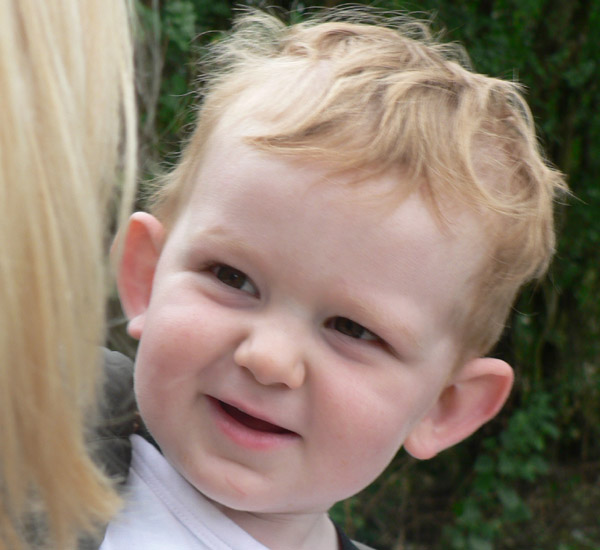
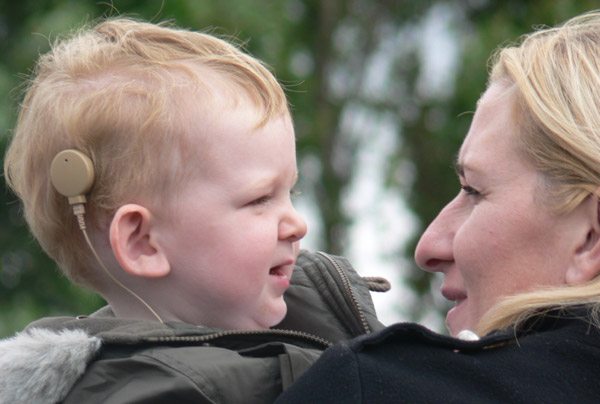
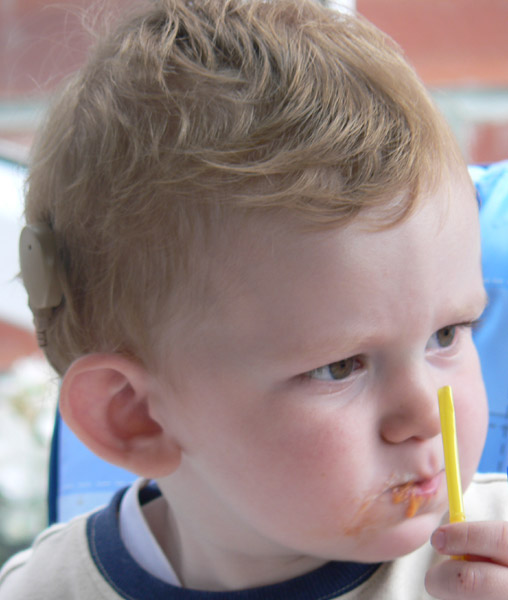
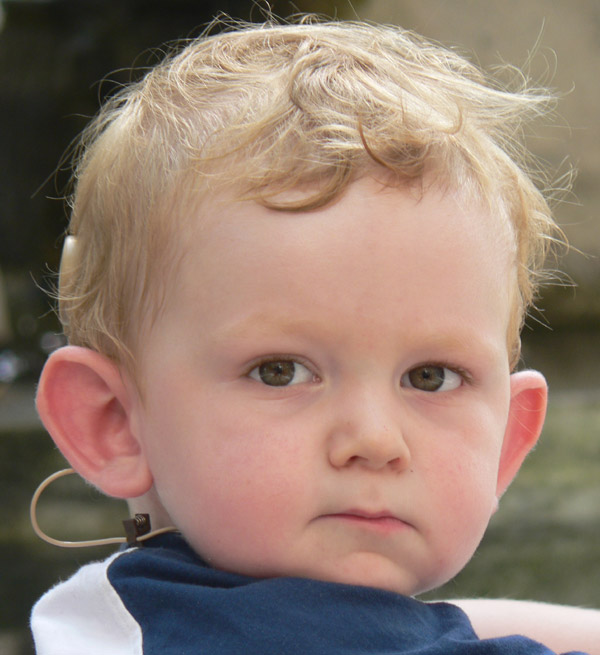
In this picture Tom is modelling the Advanced Bionics 'Clarion' device and a natty haircut courtesy of 'The Ruddy Chop', our marvellously monikered local barbers. The answer to the joke 'How many people does it take to cut Tom's hair' is four; two to hold him down, one to distract with blocks and one to perform 'guerilla hairdressing' - dive in, grab a lock and snip before the subject notices.
Friday, August 11, 2006
Two and Loving It
Tom is two now and his implant has been switched on for four weeks.
When Nicky shouts 'Jay!' up the stairs she has an echo. 'Ay!!!' yells Tom, just to make sure I've heard.
As he climbs up into his high chair or clambers down a step backwards, Tom says 'Care-ful', mimicking our cautious tone perfectly.
Tom's birthday party had something of an animal theme and since then he spots, and names, giraffes, elephants, lions, monkeys and zebras with glee. His monkey impression is something to behold and will get him out of scrapes for some time to come.
Target words for this week: 'Cement mixer', 'Dump truck' and 'Road roller'. I've not set myself much of a challenge there due to their proliferation in our house and the boy's singular obsession with all things wheeled.
The Flip Side
Tom is making this progress because of a number of key factors; all mentioned elsewhere in this blog and all worth reiterating.
When Nicky shouts 'Jay!' up the stairs she has an echo. 'Ay!!!' yells Tom, just to make sure I've heard.
As he climbs up into his high chair or clambers down a step backwards, Tom says 'Care-ful', mimicking our cautious tone perfectly.
Tom's birthday party had something of an animal theme and since then he spots, and names, giraffes, elephants, lions, monkeys and zebras with glee. His monkey impression is something to behold and will get him out of scrapes for some time to come.
Target words for this week: 'Cement mixer', 'Dump truck' and 'Road roller'. I've not set myself much of a challenge there due to their proliferation in our house and the boy's singular obsession with all things wheeled.
The Flip Side
Tom is making this progress because of a number of key factors; all mentioned elsewhere in this blog and all worth reiterating.
- We are following the Auditory Verbal therapy path with the marvellous Jacqueline Stokes.
- Tom had, when he was deafened, a pretty good vocabulary for a 20 month old and his auditory memory was developed/strong/retentive enough to cling on to 130 words plus throughout his 'silent period' which was a mercifully short three months
- Tom is learning his language in the optimally quiet environment of home with two dedicated and slightly obsessive teachers.
- He's only two and his brain is still very plastic and able to cope with change
- Nottingham know what they're doing when it comes to mapping
With all this progress being made why do we continue to fight out PCT for funding?
- Because as soon as there's poor acoustics or any background noise, Tom doesn't hear a word
- Because Tom has to look all over the place to find out who's speaking
- Because the meningitis took away the hearing in two ears, not just one
- Because there have been a number of signs that ossification has begun and we've heard of a number of cases where the effectiveness of the implanted ear has declined with progressing ossification. The thought of Tom being plunged back into silence is too awful to contemplate for long.
- Because our PCT are out of step with the rest of the world - one of the biggest US insurers, BlueCross BlueShield policy now includes bilateral implantation, following on from recent developments as reported in the Times and A Tale of Two PCTs
Feel free to add to this list - I need to go and play with my son and not dwell on this too long. I can do without an ulcer just now.
Monday, August 07, 2006
Tom's Second Birthday
Over the past few months today has been a significant point of reference for me - a date in the near future to 'get to', to make the most of when, and if, we made it. It held dramatic connotations as landmark dates in the calendar do - as markers for progress or survival.
Our neighbours have a boy the same age as Tom. That isn't a rough approximation; the difference in age is one short night that Nicky had on the maternity ward before Linda was wheeled in to the opposite bed with baby Joe; future boy next door. One can probably imagine with little difficulty how significant our relative positions felt while Tom was ill; how painful the prospect of returning to our joined houses without him. Linda and Mark, and Joe in his busy toddler way, have been vital to our recovery in the way that empathetic friends can be.
In the dark days, when the extent of Tom's potential recovery was by no means certain, Mark talked about the boys playing together again.
'August', he announced. 'They'll be running round the garden together in time for their birthdays'.
It sounded optimistic and I was far from convinced given that, at the time, he could barely move one of his arms and couldn't yet support his head.
As it was, the gallivanting and frolicking in the garden got started in July. Although somewhat cautiously on Tom's part (he is still very uncomfortable on uneven ground and won't tackle inclines without dropping to his knees), Mark's prediction came true.
Yesterday was Tom's party. His 'wellness' is slowly losing its novelty and the level of his grandparents indulgence can almost be explained as normal. He needs a little in the way of extra attention, what with that pesky coil needing to be replaced with irritating frequency but there are a number of practised hands ready to help. Joe, obviously, doesn't go in for offering special consideration. For him Tom is that kid next door who gets all the cool stuff the day before he gets his share and he has to witness it with unreserved envy. That, for now, is fine; Tom can't possibly hang on to all the trains, diggers and Bob the Builder-oriented goodies at once and there's enough of a toy overspill to share.
An uplifting day. PCTs, second implants and therapies of one kind and another can all be put to one side for a day or two. I think we all deserve that break.
Our neighbours have a boy the same age as Tom. That isn't a rough approximation; the difference in age is one short night that Nicky had on the maternity ward before Linda was wheeled in to the opposite bed with baby Joe; future boy next door. One can probably imagine with little difficulty how significant our relative positions felt while Tom was ill; how painful the prospect of returning to our joined houses without him. Linda and Mark, and Joe in his busy toddler way, have been vital to our recovery in the way that empathetic friends can be.
In the dark days, when the extent of Tom's potential recovery was by no means certain, Mark talked about the boys playing together again.
'August', he announced. 'They'll be running round the garden together in time for their birthdays'.
It sounded optimistic and I was far from convinced given that, at the time, he could barely move one of his arms and couldn't yet support his head.
As it was, the gallivanting and frolicking in the garden got started in July. Although somewhat cautiously on Tom's part (he is still very uncomfortable on uneven ground and won't tackle inclines without dropping to his knees), Mark's prediction came true.
Yesterday was Tom's party. His 'wellness' is slowly losing its novelty and the level of his grandparents indulgence can almost be explained as normal. He needs a little in the way of extra attention, what with that pesky coil needing to be replaced with irritating frequency but there are a number of practised hands ready to help. Joe, obviously, doesn't go in for offering special consideration. For him Tom is that kid next door who gets all the cool stuff the day before he gets his share and he has to witness it with unreserved envy. That, for now, is fine; Tom can't possibly hang on to all the trains, diggers and Bob the Builder-oriented goodies at once and there's enough of a toy overspill to share.
An uplifting day. PCTs, second implants and therapies of one kind and another can all be put to one side for a day or two. I think we all deserve that break.
Thursday, August 03, 2006
A Tale of Two PCTs
Yesterday (2nd August) this appeared in the Times:
Deaf toddler's parents win NHS battle
Hospital trust refused to pay for boy to have implants in both ears, then
relented after pressure
THE parents of a toddler who has become deaf in both ears were told by NHS
bosses that he could have the hearing restored in one ear, but not in both.
However, after The Times asked North Dorset Primary Care Trust (PCT) to
justify the decision, it relented and agreed to operate on both ears. The trust
denied that the call from The Times had any influence on the decision, which it
says it had been considering carefully for some time.
Later the same day we received a letter from our PCT informing us they were 'not willing to provide funding for a second cochlear implant for Tom'.
We had gone into the Appeal Panel meeting on Tuesday afternoon desperately trying to be hopeful of a positive outcome. We had opted to present our case in person rather than submit a written appeal - having felt the level of helplessness that comes with sitting by a comatose child's bed, the more involved in the process we were the better, however painful it may prove to be.
We practised and honed the presentation, covering what we regarded as all the salient points:
- the research on bilateral implants published thus far
- ongoing research reported at International Conferences,
- pertinent research regarding deafness and education, mental health and work
- the international perspective
- exceptional circumstances relating to Tom (bearing in mind he is post-meningitic, under two and had language prior to his deafness)
- testimony from bilaterally implanted children and their parents
We delivered it with the level of competence you'd hope for from an ex-teacher and a project manager. We even managed to control the waver in our voices when we touched on the more personal, emotive issues.
And, quite frankly, the whole effort was futile.
My dad, who came to drive the keyboard and whose support has been immeasurable throughout, came away thinking we had hope. I had to admire his optimism in the face of such evidence to the contrary. What I assumed, quite wrongly, to be a question and answer session to clarify our case was, in reality, an extended explanation of why they were going to turn us down. My feeling is that the panel had, to varying degrees, made up their minds long before we appeared.
PCTs can't have a blanket policy - there has to be wriggle room where 'exceptional circumstances' allow for independent decisions. Well, there has to be the appearance of it anyway; the pot is only so big as we were told in ever more imaginative ways ('we're not dumb, we understand!!' I wanted to shout) 'you know those other PCTs/countries who believe the research and stuff, well they've got more than we have...'
I tried to explain that, as much as we'd like to, we didn't have the time or the money to move to Scotland, Camden, Barnet, Norway, Iceland, Spain, Austria, Germany....or possibly North Dorset.
They may have smiled ruefully; I don't know, I was on my way out of the door.
Thursday, July 27, 2006
A Bit of a Week
I'm having what a polite Englishman might call 'a bit of a week'.
On the 1st August we go before an appeals panel. We have half an hour to explain why our son deserves to have a second implant when the Primary Care Trust’s policy is to provide funding for only one. Whatever we present in terms of our interpretation of existing evidence, the proverbial elephant will be sat in the middle of the room that the panel will be doing their best not to mention.
It all comes down to money and an ever-thinning argument relating to lack of evidence.
Studies on bilaterally implanted children are unsurprisingly few and far between at the moment and they have focused on neat audiological outcomes following closely after the surgery has taken place. Due to the extended time it takes for a scientific study to make it to the exalted status of ‘peer reviewed’ and journal publication, these short studies are all that have made it to print. The extended studies – remember we’re talking about children here; the type that can’t concentrate or get bored when being subjected to laborious scientific testing; the type that keep growing and learning, darn their cheeky little hides – are ongoing and are reporting fantastic results at conferences across the world.
The PCT will be thinking ‘this treatment costs too much’ but they can’t refuse treatment on cost alone – it has to relate to its cost-effectiveness. A single implant, when compared to none at all, falls within accepted boundaries when its QALY (Quality Adjusted Life Year) measurement is calculated, according to the one published cost-effectiveness study I can find (which is based on Adults, incidentally, who rarely score as highly on such measures having thoughtlessly squandered assorted chunks of their lives before the auditors could come along and value them). How much a given treatment improves or extends your life is the subject of an equation – an equation that can be calculated in lots of ways depending on what you choose to include or exclude. Which of the many possible or probable state-costing services will Tom need to take advantage of if he doesn’t get a second implant? How much of a gamble are the PCT willing to take? How many of them are they willing to take into account?
Does it take into account, for example, the increased likelihood of Tom needing expensive adaptations such as FM systems in all the classrooms he will visit over his full school career? How about the extent of learning support or transport costs to a school with a deaf unit or a special school? The education department are likely to have to shell out for a taxi twice a day should this eventuality come to pass, never mind the considerable increase in cost incurred by Tom attending a special school or requiring intensive learning support. Judging by the conference presentations and testimony of numerous parents, the potential difference is huge. With two implants, there’s a very real probability that Tom will need no educational support for his hearing at all. Social Services and Education have a term for the desired outcome of intervention – ‘normalisation’. Never has normal sounded so good.
How will Tom’s increased risk of poor mental health be factored in to the equation? Tom remains profoundly deaf in his left ear all the time while his right has been restored to a state described as moderate hearing loss when his implant is switched on. There is plenty of evidence of the increased communication difficulties and subsequent isolation that leads all too frequently to misbehaviour and mental health problems for children who fit this profile. For all the positivism surrounding our son’s progress thus far and our determination to ensure that nothing but the best will do, these are the sort of facts that keep me awake at night.
For every great, heart-warming anecdote about how successful a deaf person can be in this hearing world there’s a mound of statistics that suggest the truth is somewhat less rosy.
Check out the RNID’s recent employment survey for example, or this article on educational outcomes.
An ever increasing number of countries across Western Europe including Norway, Iceland, Sweden, Germany, Spain and Austria are already convinced enough. Several give bilateral implants to all suitable children while others, including Scotland, ensure that the most pressing of cases, those post-meningitic children prone to ossification, get both ears done as soon as possible.
So why do these countries accept that children will perform better with two ears than one? Have they accepted a lower threshold of proof or do they place a different level of emphasis on how much hearing is worth to a child?
I don’t believe for a second that our PCT really thinks that Tom, or indeed any child, is undeserving of a second implant, or that the jury is still out on its benefits. I’m also sure that they’re not in the business of deliberately adding to the stress and pain of fraught families who have been through the mill. I do think, though, that they’ve got their fingers in their ears and are singing ‘la-la-la I can’t hear you’ at the top of their voices with regard to the evidence. It’s just a matter of a few months or years before much more material is published and, if they stick to their criteria, they have to reconsider their policy.
Unfortunately, that’s way too late for us. Tom had a shadow on his MRI that our consultant took to be the early stages of ossification – his window of opportunity for gaining maximum benefit from a second implant is closing rapidly. In fact there’s a slightly larger window swinging slowly shut on all deaf children; the longer the auditory nerve pathways aren’t stimulated on the unimplanted side, the harder it gets until, eventually, some other opportunistic part of the brain spots the neural capacity going begging and says ‘I’ll have those’. And there goes the opportunity.
So we may get answers to some of these questions on the 1st. Actually, we’ll only get the one answer and the key part of it will be rather short and to the point.
Think about us.
On the 1st August we go before an appeals panel. We have half an hour to explain why our son deserves to have a second implant when the Primary Care Trust’s policy is to provide funding for only one. Whatever we present in terms of our interpretation of existing evidence, the proverbial elephant will be sat in the middle of the room that the panel will be doing their best not to mention.
It all comes down to money and an ever-thinning argument relating to lack of evidence.
Studies on bilaterally implanted children are unsurprisingly few and far between at the moment and they have focused on neat audiological outcomes following closely after the surgery has taken place. Due to the extended time it takes for a scientific study to make it to the exalted status of ‘peer reviewed’ and journal publication, these short studies are all that have made it to print. The extended studies – remember we’re talking about children here; the type that can’t concentrate or get bored when being subjected to laborious scientific testing; the type that keep growing and learning, darn their cheeky little hides – are ongoing and are reporting fantastic results at conferences across the world.
The PCT will be thinking ‘this treatment costs too much’ but they can’t refuse treatment on cost alone – it has to relate to its cost-effectiveness. A single implant, when compared to none at all, falls within accepted boundaries when its QALY (Quality Adjusted Life Year) measurement is calculated, according to the one published cost-effectiveness study I can find (which is based on Adults, incidentally, who rarely score as highly on such measures having thoughtlessly squandered assorted chunks of their lives before the auditors could come along and value them). How much a given treatment improves or extends your life is the subject of an equation – an equation that can be calculated in lots of ways depending on what you choose to include or exclude. Which of the many possible or probable state-costing services will Tom need to take advantage of if he doesn’t get a second implant? How much of a gamble are the PCT willing to take? How many of them are they willing to take into account?
Does it take into account, for example, the increased likelihood of Tom needing expensive adaptations such as FM systems in all the classrooms he will visit over his full school career? How about the extent of learning support or transport costs to a school with a deaf unit or a special school? The education department are likely to have to shell out for a taxi twice a day should this eventuality come to pass, never mind the considerable increase in cost incurred by Tom attending a special school or requiring intensive learning support. Judging by the conference presentations and testimony of numerous parents, the potential difference is huge. With two implants, there’s a very real probability that Tom will need no educational support for his hearing at all. Social Services and Education have a term for the desired outcome of intervention – ‘normalisation’. Never has normal sounded so good.
How will Tom’s increased risk of poor mental health be factored in to the equation? Tom remains profoundly deaf in his left ear all the time while his right has been restored to a state described as moderate hearing loss when his implant is switched on. There is plenty of evidence of the increased communication difficulties and subsequent isolation that leads all too frequently to misbehaviour and mental health problems for children who fit this profile. For all the positivism surrounding our son’s progress thus far and our determination to ensure that nothing but the best will do, these are the sort of facts that keep me awake at night.
For every great, heart-warming anecdote about how successful a deaf person can be in this hearing world there’s a mound of statistics that suggest the truth is somewhat less rosy.
Check out the RNID’s recent employment survey for example, or this article on educational outcomes.
An ever increasing number of countries across Western Europe including Norway, Iceland, Sweden, Germany, Spain and Austria are already convinced enough. Several give bilateral implants to all suitable children while others, including Scotland, ensure that the most pressing of cases, those post-meningitic children prone to ossification, get both ears done as soon as possible.
So why do these countries accept that children will perform better with two ears than one? Have they accepted a lower threshold of proof or do they place a different level of emphasis on how much hearing is worth to a child?
I don’t believe for a second that our PCT really thinks that Tom, or indeed any child, is undeserving of a second implant, or that the jury is still out on its benefits. I’m also sure that they’re not in the business of deliberately adding to the stress and pain of fraught families who have been through the mill. I do think, though, that they’ve got their fingers in their ears and are singing ‘la-la-la I can’t hear you’ at the top of their voices with regard to the evidence. It’s just a matter of a few months or years before much more material is published and, if they stick to their criteria, they have to reconsider their policy.
Unfortunately, that’s way too late for us. Tom had a shadow on his MRI that our consultant took to be the early stages of ossification – his window of opportunity for gaining maximum benefit from a second implant is closing rapidly. In fact there’s a slightly larger window swinging slowly shut on all deaf children; the longer the auditory nerve pathways aren’t stimulated on the unimplanted side, the harder it gets until, eventually, some other opportunistic part of the brain spots the neural capacity going begging and says ‘I’ll have those’. And there goes the opportunity.
So we may get answers to some of these questions on the 1st. Actually, we’ll only get the one answer and the key part of it will be rather short and to the point.
Think about us.
Friday, July 21, 2006
Carry On Talking
‘Out!!’
Forcefully delivered, uncompromisingly direct and usually accompanied by a furrowed brow, ‘Out’ has been Tom’s instruction of choice for some months, dating back to the hazy pre-meningitic days when we sometimes said no to his insistent requests. He has found a broad range of uses for ‘out’ – indicating his desire to leave the house, extricate a favourite car from a toy box tangle, get at food in a container or opening a cupboard door. It’s a useful word when you’re not quite two and issues of correctness just don’t figure – it gets your point across and usually delivers results. We did what I suspect most parents did; chuckled indulgently at how cute our oh-so-serious son was and did his bidding, more often than not mimicking him. There was plenty of time for building the correct vocabulary later. As it turns out, we were right but not without it looking highly unlikely for a time.
Yesterday I got home from a day in London and called ‘Hello Tom’ from the kitchen doorway. Engrossed in a game with his Granny and at some distance away, Tom didn’t respond. Of course he didn’t, he has had his implant barely a week and is almost certainly unable to distinguish between voice and noise at any distance. But we know this will come because we’ve seen what he can do already.
‘Tom, look it’s daddy’ says Granny, who’s kneeling on the floor. She’s at his level and near the microphone, situated in the coil magnetically attached to the right hand side of his head. He looks up to her and then turns round; no visual cues have alerted him to my presence. He’s heard and understood and responded. Then he does what every father loves and comes running to me shouting ‘Daddy!!!’ with a big smile on his face, demanding a cuddle. You just can’t beat that.
Tom is keen on cuddles. I don’t doubt that there’s a seed of affection in there but he’s not above a bit of exploitation when he’s got the parent of choice in his emotional grip. Cuddles bring with them a height advantage which enables the scanning of normally invisible kitchen surfaces and access to handles of unsecured cupboards. He knows this is where we keep the good stuff and we can’t help but find this deviousness endearing.
‘Apple!, ‘Suma!’ – his eyes alight on the fruit bowl. Picking the Satsuma up, he offers it to me and says ‘peel’. Clear as day. No more the ubiquitous ‘Out!’; in with the sophisticated, food-specific ‘peel’. I sense a Granny at work.
Like any good servile father I do as I’m bid; vainly try and restrict how many segments are crammed in his mouth at once and then watch in amazement as Granny’s request for Tom to ‘put the peel in the bin’ is followed to the letter.
The Cochlear Implant Team and our Teacher for the Deaf have all, in the gentlest and kindest of manners, encouraged us to round our expectations down.
‘These things take time’
‘He needs to get used to the new sounds’
Tom doesn’t appear to agree. Just as he’s taken to running and trying to jump while his balance is still off (he corners like a drunk – imagine one wrist tied to a tent peg and trying to run away in a Laurel and Hardy style), Tom has decided to carry on talking. As far as his expressive language goes, he’s picking up three or four new words a day while his receptive language is developing too as the bin and daddy examples show. The implant is working – it’s allowing Tom the access to sound he needs to do what all toddlers his age are capable of; the phenomenal, sponge-like acquisition of language.
So we’ve had a bit of a flyer out of the blocks. Tom started from a really strong position; he had a fairly large vocabulary for a child his age when he was deafened, the period of silence was relatively short at three months and he kept using most of his words throughout that period. On top of that, after periods of helplessness and waiting, we finally had a concrete way of helping and so sought out the best advice we could.
Answering ‘Nottingham’ to the ‘where did you get your implant done?’ to most people in our new Cochlear World and the response, sometimes tinged with a little envy, is invariably positive. They’ve been implanting children longer than anyone else in the country and have done more than anyone else. Read the research papers and the same Nottingham-based names crop up over and again. These are guys with an enviable reputation and we struggle to fault the care we’ve had. That praise extends through to our marvellous Teacher for the Deaf, Tanya Sorrenti.
For us though, the softly, softly approach to therapeutic aftercare didn’t feel like enough. A simple message from my teaching days loitered in my mind:
‘High expectations, high achievement’
Tom was born to talk. To watch him enthusiastically take up signing provided further proof. We had to give Tom the very best and expect great things. We hunted around for inspiration and discovered the John Tracy Clinic. Based in LA, the clinic offers free correspondence courses to the families of deafened children. These explain and offer methods of helping children develop language and monitoring their progress. The first lesson arrived last week and it looks good; it offers a structure and, more importantly, a brand of undiluted enthusiasm that the Americans do so much better than us.
This week also brought our first session with Jacqueline Stokes of AV UK. Based near Oxford, Jacqueline and her team are pioneers of auditory verbal therapy in the UK; an approach to teaching deaf children the skills they need to listen and acquire language. Based on one session and a viewing of its video recording, I believe Jacqueline may be on to something. I have never been told off that much in 20 years but to see the attentiveness in Tom’s face and to witness the results as we’ve followed her techniques – what’s dignity for anyway?
The implant has thrown him back into the noisy, chatty world and he loves it.
Forcefully delivered, uncompromisingly direct and usually accompanied by a furrowed brow, ‘Out’ has been Tom’s instruction of choice for some months, dating back to the hazy pre-meningitic days when we sometimes said no to his insistent requests. He has found a broad range of uses for ‘out’ – indicating his desire to leave the house, extricate a favourite car from a toy box tangle, get at food in a container or opening a cupboard door. It’s a useful word when you’re not quite two and issues of correctness just don’t figure – it gets your point across and usually delivers results. We did what I suspect most parents did; chuckled indulgently at how cute our oh-so-serious son was and did his bidding, more often than not mimicking him. There was plenty of time for building the correct vocabulary later. As it turns out, we were right but not without it looking highly unlikely for a time.
Yesterday I got home from a day in London and called ‘Hello Tom’ from the kitchen doorway. Engrossed in a game with his Granny and at some distance away, Tom didn’t respond. Of course he didn’t, he has had his implant barely a week and is almost certainly unable to distinguish between voice and noise at any distance. But we know this will come because we’ve seen what he can do already.
‘Tom, look it’s daddy’ says Granny, who’s kneeling on the floor. She’s at his level and near the microphone, situated in the coil magnetically attached to the right hand side of his head. He looks up to her and then turns round; no visual cues have alerted him to my presence. He’s heard and understood and responded. Then he does what every father loves and comes running to me shouting ‘Daddy!!!’ with a big smile on his face, demanding a cuddle. You just can’t beat that.
Tom is keen on cuddles. I don’t doubt that there’s a seed of affection in there but he’s not above a bit of exploitation when he’s got the parent of choice in his emotional grip. Cuddles bring with them a height advantage which enables the scanning of normally invisible kitchen surfaces and access to handles of unsecured cupboards. He knows this is where we keep the good stuff and we can’t help but find this deviousness endearing.
‘Apple!, ‘Suma!’ – his eyes alight on the fruit bowl. Picking the Satsuma up, he offers it to me and says ‘peel’. Clear as day. No more the ubiquitous ‘Out!’; in with the sophisticated, food-specific ‘peel’. I sense a Granny at work.
Like any good servile father I do as I’m bid; vainly try and restrict how many segments are crammed in his mouth at once and then watch in amazement as Granny’s request for Tom to ‘put the peel in the bin’ is followed to the letter.
The Cochlear Implant Team and our Teacher for the Deaf have all, in the gentlest and kindest of manners, encouraged us to round our expectations down.
‘These things take time’
‘He needs to get used to the new sounds’
Tom doesn’t appear to agree. Just as he’s taken to running and trying to jump while his balance is still off (he corners like a drunk – imagine one wrist tied to a tent peg and trying to run away in a Laurel and Hardy style), Tom has decided to carry on talking. As far as his expressive language goes, he’s picking up three or four new words a day while his receptive language is developing too as the bin and daddy examples show. The implant is working – it’s allowing Tom the access to sound he needs to do what all toddlers his age are capable of; the phenomenal, sponge-like acquisition of language.
So we’ve had a bit of a flyer out of the blocks. Tom started from a really strong position; he had a fairly large vocabulary for a child his age when he was deafened, the period of silence was relatively short at three months and he kept using most of his words throughout that period. On top of that, after periods of helplessness and waiting, we finally had a concrete way of helping and so sought out the best advice we could.
Answering ‘Nottingham’ to the ‘where did you get your implant done?’ to most people in our new Cochlear World and the response, sometimes tinged with a little envy, is invariably positive. They’ve been implanting children longer than anyone else in the country and have done more than anyone else. Read the research papers and the same Nottingham-based names crop up over and again. These are guys with an enviable reputation and we struggle to fault the care we’ve had. That praise extends through to our marvellous Teacher for the Deaf, Tanya Sorrenti.
For us though, the softly, softly approach to therapeutic aftercare didn’t feel like enough. A simple message from my teaching days loitered in my mind:
‘High expectations, high achievement’
Tom was born to talk. To watch him enthusiastically take up signing provided further proof. We had to give Tom the very best and expect great things. We hunted around for inspiration and discovered the John Tracy Clinic. Based in LA, the clinic offers free correspondence courses to the families of deafened children. These explain and offer methods of helping children develop language and monitoring their progress. The first lesson arrived last week and it looks good; it offers a structure and, more importantly, a brand of undiluted enthusiasm that the Americans do so much better than us.
This week also brought our first session with Jacqueline Stokes of AV UK. Based near Oxford, Jacqueline and her team are pioneers of auditory verbal therapy in the UK; an approach to teaching deaf children the skills they need to listen and acquire language. Based on one session and a viewing of its video recording, I believe Jacqueline may be on to something. I have never been told off that much in 20 years but to see the attentiveness in Tom’s face and to witness the results as we’ve followed her techniques – what’s dignity for anyway?
The implant has thrown him back into the noisy, chatty world and he loves it.
Thursday, July 20, 2006
The hero of the piece
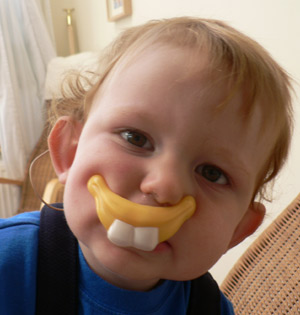
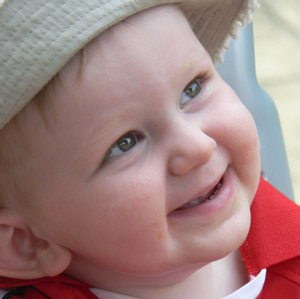
Despite the dummy withdrawal, the boy remains remarkably cheery and finds coping strategies.
Monday, July 17, 2006
In which Tom decides that hearing is a jolly fine idea
Tom and paddling pools - they're never really going to be friends. The water is never warm enough, there's always stuff floating around in them (he's on a bit of a cleanliness kick at the moment - a future in painting is probably off the agenda) and now it involves taking his ear off too - something that, as the weekend went on, didn't seem such a good idea.
I think you can get a fairly clear impression of the sort of weekend we had by mulling over the following overused phrases:
I think you can get a fairly clear impression of the sort of weekend we had by mulling over the following overused phrases:
- 'Can you hear the .... Tom?'
- 'Did he use that word before?'
- 'Pass the suncream'
- 'Your ear's fallen off again' (the neighbours must have puzzled over that one)
And what was Tom saying during this time? Well, all manner of mumbled stuff through his dummy. Oh, and 'Dummy!!', of course, when we took it off him to try and hear what he was saying.
That darn thing has just got to go. I don't know what we were thinking; our son comes round from a coma, asked for a dummy in a hoarse croak (brought on by being intubated) and we just crumbled like the weak, ineffectual parents we are. It's enough to give Gina Ford conniptions.
By Sunday the parenting and grandparenting collective were pretty convinced that Tom understood the word 'wee-wee' - having announced it after peeing in the garden and attempting to mop it up with Granny's shirt. I would've let him as a reward but the proposal was vetoed.
There were numerous other clues that Tom was enjoying the experience; musical toys got alot more attention, squeaky doors just had to be opened and closed over and over, the 'bang' that colliding toy cars made just had to be shouted to the hills. The 'eyes well up' moment came for me when we opened a farm animal book, I asked 'Where's the duck?' and Tom's finger went straight to it, accompanied by a very satisfying, very endearing and quite resounding 'Quack, quack!!'
Saturday, July 15, 2006
'Ears'
'So Tom can hear now then?'
'Well, yes - he just doesn't know what he hears'
This is a fairly close approximation to the question I was asked numerous times yesterday evening and the stock answer I honed with practise. Family and friends had all been waiting for the second of Tom's initial 'switch on' mapping sessions yesterday morning and were desperate for positive news. I didn't feel able to explain how we had watched and played with curious apprehension as the dynamic audiological duo, Kim and Mark, had run through their various routines. This is my attempt now.
Tom arrives at the soundproof booths with a heightened sense of anticipation now, having discovered that Assessment Centre's stock of toys runs to a parking garage and a considerable number of cars. Having scoped the joint on Thursday, he made a beeline for the garage's hiding place the moment we arrived on Friday and demanded its retrieval. Within seconds he was installed at a table with everything set out before him and ready to go. Aware that windows of cooperation have to be seized on with toddlers, things got under way pretty quickly.
To the uninvolved eye, the process of mapping a cochlear implant has more than a degree of hypnotic tedium about it. The transmitter on the subject's head is connected directly to a computer and a series of impulses are sent to stimulate one or more of the electrodes coiled neatly inside the cochlea. A series of beeps is provided for the 'audience' to make them aware that stimuli are being applied. And that's kind of it - over and over at different frequencies and different intensities - while the audiologists and parents just stare intently waiting for an outward sign that something is being registered. Cochlear Implant mapping is a spectator sport and, like going to watch greyhound racing, its only really of interest to the aficionado or those who've wagered their shirt on the outcome.
To stretch the 'mapping as a trip to the dogs at Catford Stadium' metaphor a little further, the aficionados see things that the average punter completely misses; the baulk out of the gate, the hint of lameness. In Tom's case, this amounted to almost imperceptible eyelid flutters in response to certain intensities of sound and elongated pauses during his play. While I was busy hunting for the next chocolate drop bribe, Kim, with Mark behind the mildly intimidating one-way glass, were noting these subtle responses. They appeared satisfied with what they saw while Nik and I, the average punters , needed something a little more concrete to convince us that the magic had started.
Thankfully, it came.
For the final phase of testing, all Tom's electrodes were switched on and the stimuli were sounds played through a speaker rather than impulses transmitted directly to the array. As soon as the first sound came out Tom turned, looking for the source. He was back in the hearing business, we could go home content.
That, however, wasn't to be the end of it.
During a short session with Amanda, an implant team speech therapist, Tom got his hands on a keyboard and started plunking away. We've watched with choked sadness over the past few months when he's played with musical toys at home only to discover that, seemingly, all their batteries have gone dead at once, and quickly lose interest. Not this time; he belted away on the keys, sounding to us like Bach, Jerry Lee Lewis and my drunk brother-in-law all rolled in to one.
At the end of his short recital he looked at me, pointed to the side of his head and said 'Ears!'
Blimey.
'Well, yes - he just doesn't know what he hears'
This is a fairly close approximation to the question I was asked numerous times yesterday evening and the stock answer I honed with practise. Family and friends had all been waiting for the second of Tom's initial 'switch on' mapping sessions yesterday morning and were desperate for positive news. I didn't feel able to explain how we had watched and played with curious apprehension as the dynamic audiological duo, Kim and Mark, had run through their various routines. This is my attempt now.
Tom arrives at the soundproof booths with a heightened sense of anticipation now, having discovered that Assessment Centre's stock of toys runs to a parking garage and a considerable number of cars. Having scoped the joint on Thursday, he made a beeline for the garage's hiding place the moment we arrived on Friday and demanded its retrieval. Within seconds he was installed at a table with everything set out before him and ready to go. Aware that windows of cooperation have to be seized on with toddlers, things got under way pretty quickly.
To the uninvolved eye, the process of mapping a cochlear implant has more than a degree of hypnotic tedium about it. The transmitter on the subject's head is connected directly to a computer and a series of impulses are sent to stimulate one or more of the electrodes coiled neatly inside the cochlea. A series of beeps is provided for the 'audience' to make them aware that stimuli are being applied. And that's kind of it - over and over at different frequencies and different intensities - while the audiologists and parents just stare intently waiting for an outward sign that something is being registered. Cochlear Implant mapping is a spectator sport and, like going to watch greyhound racing, its only really of interest to the aficionado or those who've wagered their shirt on the outcome.
To stretch the 'mapping as a trip to the dogs at Catford Stadium' metaphor a little further, the aficionados see things that the average punter completely misses; the baulk out of the gate, the hint of lameness. In Tom's case, this amounted to almost imperceptible eyelid flutters in response to certain intensities of sound and elongated pauses during his play. While I was busy hunting for the next chocolate drop bribe, Kim, with Mark behind the mildly intimidating one-way glass, were noting these subtle responses. They appeared satisfied with what they saw while Nik and I, the average punters , needed something a little more concrete to convince us that the magic had started.
Thankfully, it came.
For the final phase of testing, all Tom's electrodes were switched on and the stimuli were sounds played through a speaker rather than impulses transmitted directly to the array. As soon as the first sound came out Tom turned, looking for the source. He was back in the hearing business, we could go home content.
That, however, wasn't to be the end of it.
During a short session with Amanda, an implant team speech therapist, Tom got his hands on a keyboard and started plunking away. We've watched with choked sadness over the past few months when he's played with musical toys at home only to discover that, seemingly, all their batteries have gone dead at once, and quickly lose interest. Not this time; he belted away on the keys, sounding to us like Bach, Jerry Lee Lewis and my drunk brother-in-law all rolled in to one.
At the end of his short recital he looked at me, pointed to the side of his head and said 'Ears!'
Blimey.
Thursday, July 13, 2006
'No satsuma, no coil'
Our son beeps alot now. There's an alarm that goes off on Tom's body-worn processor whenever the magnetic microphone/coil unlocks from its docking point on the side of his head. For unlock, read 'falls off'.
And, when I say 'side of his head' I'm referring to a sophisticated receiver coil (three turns of gold wire I believe) sitting in a drilled out recess of his skull just under his skin. I'm not sure I'll ever get used to that.
So Tom has taken his first tentative steps back into this world of sound - actually it's more like he's hovering in the doorway. The audiological team spent around forty minutes with Tom plugged in to the software running a series of initial tests to make sure the electrode array was all tickety-boo followed by a behavioural test with the dancing toys in boxes at the sides of the room being lit up as a 'reward' for hearing the sound. The boy's been through this one on a number of occasions over the past couple of months and has started checking the boxes every once in a while just in case the nodding dinosaur should show its face.
Incidentally, Tom referred to the dinosaur as a 'ribbit' - a generic term applied to pretty much all things green. I haven't the heart , or the necessary signing skills, to correct him.
The first session ends with Tom in his comfy harness with a neat, under-the-arm holster for the processor. After the initial bribery required a couple of days ago (we've really spun out the Easter eggs this year - comes from spending a large chunk of the spring in hospital) we've had no objections to the coil and associated gadgetry. That is, except for a neat reversal of the 'no coil, no dummy' blackmail - my failure to deliver a desired piece of fruit led to Tom responding with 'no satsuma, no coil'. He catches on fast.
As for hearing anything or responding to sound? Nada. The processor is turned on at the equivalent of little more than a loud whisper - we're back in today for further, more precise 'tuning' - and there's a significant amount of adapting for his brain to do but you hope to see something, don't you? Importantly, Tom's happy with wearing the kit and has been the model of cooperation thus far so we haven't had any extra grief layered on top of the base level of stress.
Which reminds me, we still haven't stocked up on satsumas.
And, when I say 'side of his head' I'm referring to a sophisticated receiver coil (three turns of gold wire I believe) sitting in a drilled out recess of his skull just under his skin. I'm not sure I'll ever get used to that.
So Tom has taken his first tentative steps back into this world of sound - actually it's more like he's hovering in the doorway. The audiological team spent around forty minutes with Tom plugged in to the software running a series of initial tests to make sure the electrode array was all tickety-boo followed by a behavioural test with the dancing toys in boxes at the sides of the room being lit up as a 'reward' for hearing the sound. The boy's been through this one on a number of occasions over the past couple of months and has started checking the boxes every once in a while just in case the nodding dinosaur should show its face.
Incidentally, Tom referred to the dinosaur as a 'ribbit' - a generic term applied to pretty much all things green. I haven't the heart , or the necessary signing skills, to correct him.
The first session ends with Tom in his comfy harness with a neat, under-the-arm holster for the processor. After the initial bribery required a couple of days ago (we've really spun out the Easter eggs this year - comes from spending a large chunk of the spring in hospital) we've had no objections to the coil and associated gadgetry. That is, except for a neat reversal of the 'no coil, no dummy' blackmail - my failure to deliver a desired piece of fruit led to Tom responding with 'no satsuma, no coil'. He catches on fast.
As for hearing anything or responding to sound? Nada. The processor is turned on at the equivalent of little more than a loud whisper - we're back in today for further, more precise 'tuning' - and there's a significant amount of adapting for his brain to do but you hope to see something, don't you? Importantly, Tom's happy with wearing the kit and has been the model of cooperation thus far so we haven't had any extra grief layered on top of the base level of stress.
Which reminds me, we still haven't stocked up on satsumas.
Subscribe to:
Comments (Atom)